 VirtuProbe Studio
VirtuProbe Studio
VirtuProbe Studio
Two of the most reliable moves against an Active Directory domain — AS-REP Roasting and Kerberoasting — come down to asking the KDC a polite question and cracking the answer offline. Here's how to run both at the wire in VirtuProbe, why talking straight to the KDC beats a wrapper, and how to chain the whole thing off an LDAP lookup.
Kerberos pre-authentication is one of those protocol details that turns into an attack the moment an account is configured slightly wrong. Both of the techniques here exploit exactly that: they get the KDC to hand back something encrypted with a key derived from a user's or service account's password, then crack it offline where no lockout policy can see you.
VirtuProbe's Kerberos probe talks directly to a Key Distribution Center with a hand-rolled RFC 4120 implementation — no GSSAPI, no third-party Kerberos library between you and the wire. That matters more than it sounds, and I'll come back to why. First, the two attacks.
Add a Kerberos probe and point it at the domain controller. The connection settings are minimal:
88 by default.LAB.LOCAL).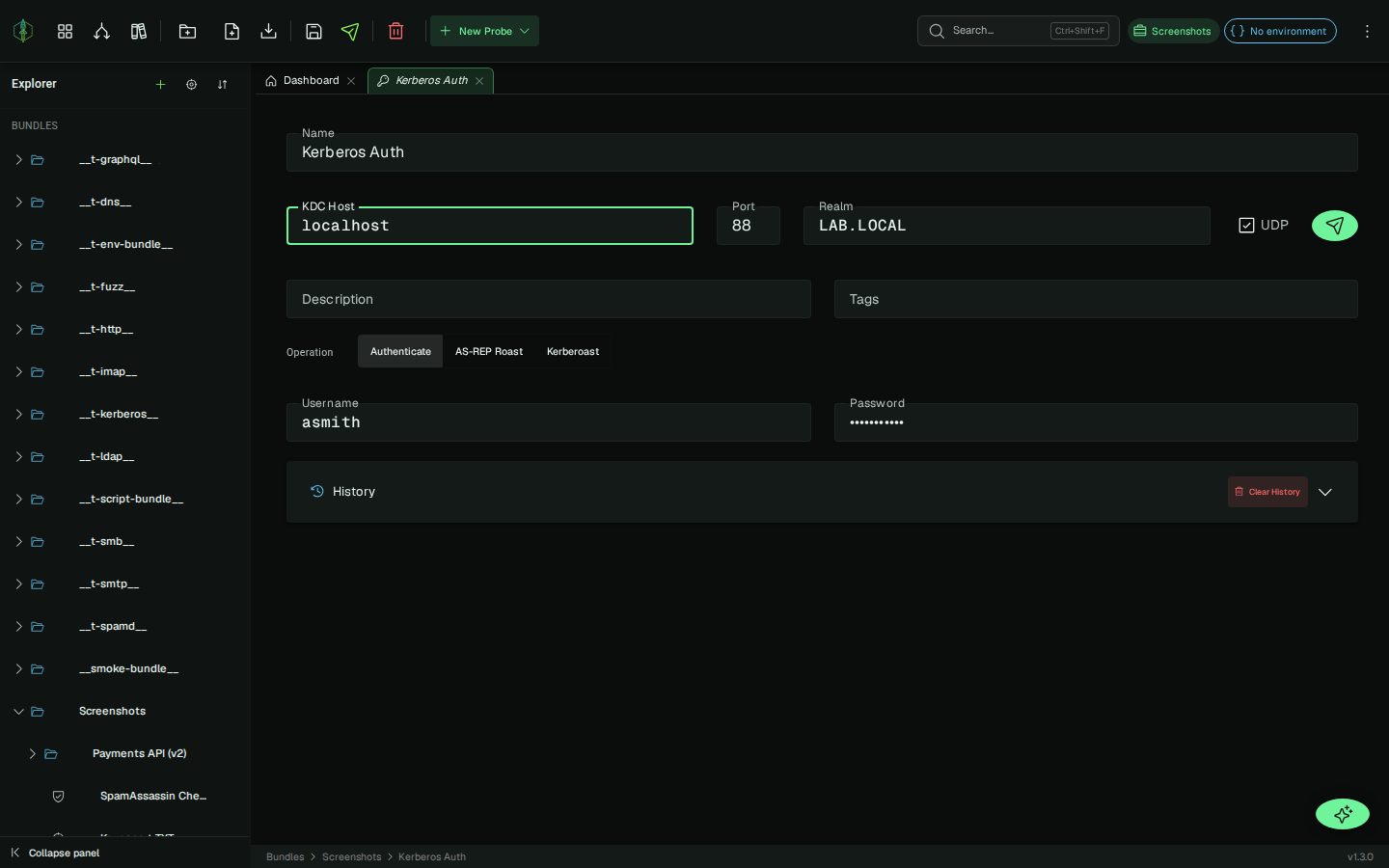
AS-REP Roasting targets accounts that have Do not require Kerberos pre-authentication set (DONT_REQUIRE_PREAUTH). Normally the client proves it knows the password by encrypting a timestamp before the KDC will respond. Turn pre-auth off, and the KDC will happily send back an AS-REP whose encrypted part is derived from the account's password — to anyone who asks, no password needed.
Set the probe's Operation to AS-REP Roast and give it just a username. No password. If the account is vulnerable, the response comes back with the hash already formatted for hashcat mode 18200:
$krb5asrep$23$jdoe@LAB.LOCAL:a1b2c3...16hex...$rest...The hash lands in a copy-ready card labelled with its hashcat mode. Copy it and crack offline:
hashcat -m 18200 hash.txt wordlist.txtIf the account requires pre-auth (the normal case), you get a clean FAIL instead — no hash, no harm. Which makes this a fast enumeration sweep: fire it across a username list and the hits are the misconfigured accounts.
Kerberoasting goes one step deeper. With any valid domain credentials, you obtain a TGT, then request a service ticket (TGS) for a target Service Principal Name. The service ticket's encrypted part is sealed with the service account's password hash — so cracking it gives you that account's password, often a high-privilege service identity.
Switch the Operation to Kerberoast and fill in:
HTTP/web.lab.local or MSSQLSvc/db.lab.local:1433.The probe authenticates, pulls the TGT, requests the service ticket, and returns the hash in hashcat mode 13100 format:
$krb5tgs$23$*svc_iis*LAB.LOCAL*HTTP/web.lab.local*$a1b2c3...16hex...$rest...hashcat -m 13100 hash.txt wordlist.txtThe probe implements RFC 4120 (Kerberos V5) and RFC 4757 (RC4-HMAC-MD5) from scratch — hand-written ASN.1 DER, the full MD4 NT-hash → key-derivation → RC4 → HMAC-MD5 path, UDP with TCP fallback. There's no library sitting in the middle deciding what's well-formed.
That's the difference between a tool that uses Kerberos and one you can probe it with. The Exchanges panel shows every message pair — AS-REQ / AS-REP, TGS-REQ / TGS-REP — down to the raw DER hex, exactly as it went on the wire, un-normalised. When a KDC does something subtly non-standard, that raw view is the difference between "it didn't work" and "here's precisely why."
Running one roast is useful. The real leverage is that a Kerberos step is just another probe — so it drops into a chain alongside every other protocol. A natural Active Directory flow:
ITERATE loop; feed it from the LDAP result or a wordlist file, with jitter between requests and stop-on-first-success if you want it.KERBEROS_SUCCESS, KERBEROS_HASH and KERBEROS_ERROR_CODE, and collect the crackable hashes as evidence.That's enumeration and roasting in a single runnable artefact you can replay on the next engagement — instead of three CLI tools, a text file, and a shell loop you rewrite every time. Every run is saved to history with the realm and username, and exports as structured JSON for the report.
Try it on a lab domain. VirtuProbe Studio is free to download — no account, no cloud, no telemetry. The Kerberos probe is a Security-tier feature, and free for students and academics via the Academic License.